The Hidden Cost of Aluminium
Aluminium is everywhere.
It is lightweight, versatile, durable and endlessly recyclable. But before aluminium reaches our homes, bathrooms and kitchens, it begins its journey as bauxite – an ore that has to be mined from the earth. And that mining can come at a significant environmental cost.
At KorQoo, this is where our story began. We started asking a simple question: Could there be a better alternative to the everyday aluminium products we use and replace without thinking about where they came from?
The answer led us to cork. But first, it is important to understand the problem we were trying to solve.
Bauxite mining starts with the land
Bauxite is the primary ore used to produce aluminium. It is found close to the Earth’s surface, meaning mining often involves clearing vegetation, removing soil and creating large open mining areas.
That can mean the loss and fragmentation of forests and habitats, disruption to ecosystems and pressure on wildlife. Bauxite deposits can occur in some of the world’s most environmentally important forests and biodiverse regions.
In Western Australia, for example, bauxite mining has affected the Northern Jarrah Forest – habitat for nationally protected species including black cockatoos.
In Ghana, proposed bauxite mining in the Atewa Forest has raised concerns because the forest is a globally significant biodiversity area and the source of three major rivers which provide water for millions of people.
These are reminders that the environmental story behind aluminium isn’t simply about a finished product. It starts much earlier – in the landscape where the raw material is taken from.
Then comes the red mud
Mining the bauxite is only part of the story. The ore has to be refined to extract alumina, which is then used to produce aluminium.
One of the major by-products of this process is known as bauxite residue, commonly called red mud. And there is an enormous amount of it. Around 4 billion tonnes of bauxite residue are estimated to be stored globally.
Think about that for a moment. Four billion tonnes. That’s an extraordinary amount of industrial waste sitting in storage around the world. Red mud is highly alkaline, with reported pH levels around 10–13 and can contain a complex mixture of minerals and trace metals. Managing it safely requires long-term containment and monitoring.
It can be stored in large containment areas, ponds, dams or dry-stacked deposits. While the industry is working on ways to reuse and better manage this material, the sheer scale of the existing stockpile remains a major environmental challenge.
The environmental cost is bigger than one product
It is easy to look at an aluminium tin and see only the finished object. But behind that object is a much bigger chain:
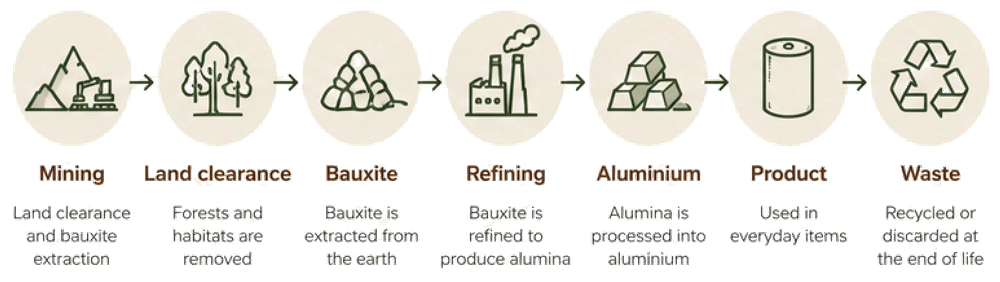
Every material has an environmental footprint.
That doesn’t mean aluminium has no place in a sustainable future. Aluminium can be highly valuable and recycling aluminium is important. But it does mean we should think carefully about where aluminium is genuinely necessary – and where alternatives could work just as well, if not better!
Sources of research and media coverage
Further reading on bauxite mining, red mud and the environmental impact of aluminium.
- Feds probe more illegal clearing by Alcoa after ‘deliberate repeat’ destruction of Jarrah forest Western Australia
- Malawi’s Unesco mountain and a bauxite mining proposal
- Rainforest Rescue v Aluminium
- Odisha Gov’t alter wildlife sanctuary map for bauxite mine India
- Questions raised over red-coloured water near the bauxite mines